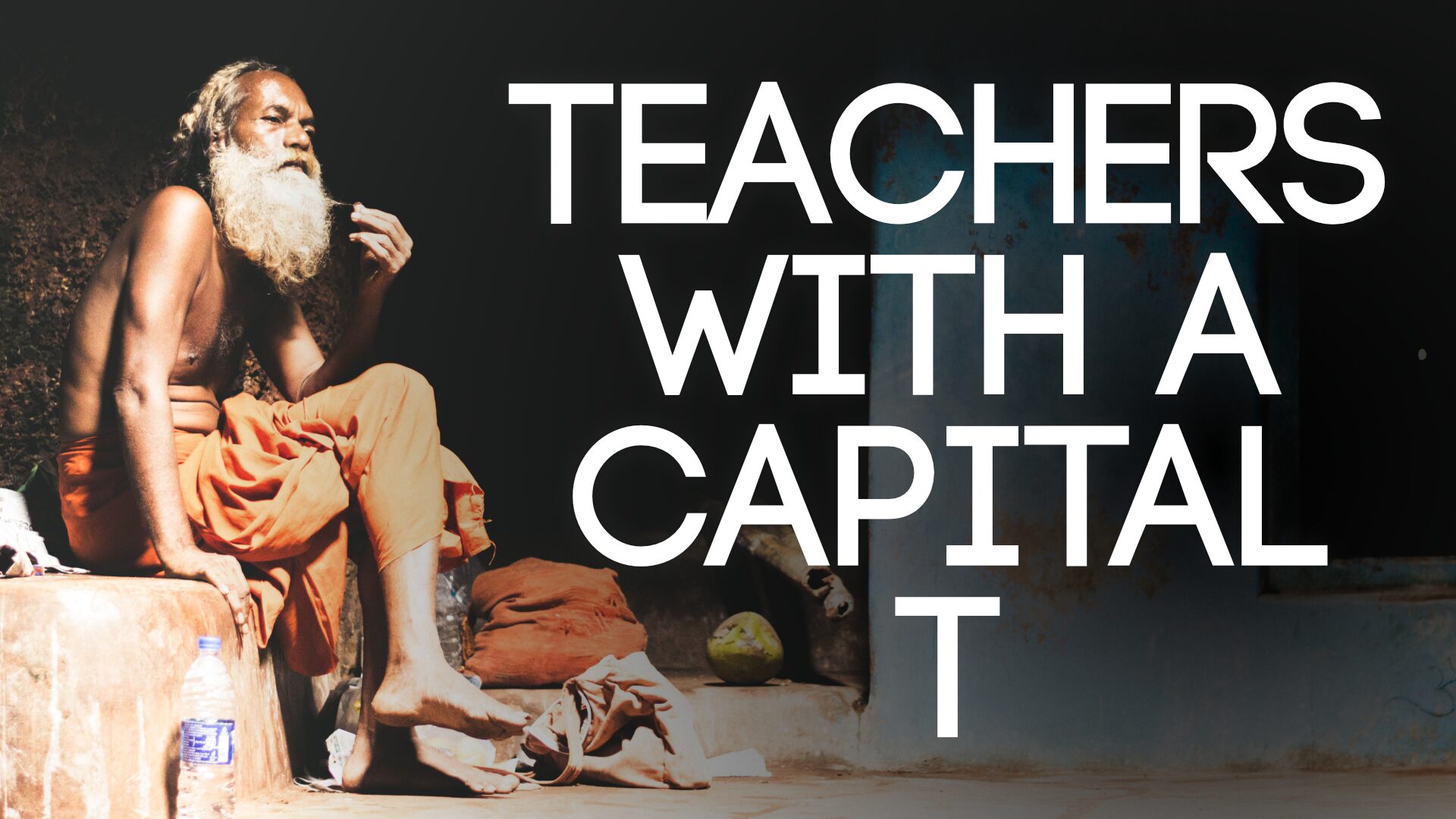
Over the last number of years, I have spent some time worrying about not having a teacher, or more correctly, a spiritual teacher or guru.
From reading various spiritual books and accounts, particularly those from or influenced by the East, it feels like having a teacher is pretty much step 1, and if you don’t have one, then you are missing out—and probably not going to end up where you want to be, spiritually or magickally speaking.
And so I thought, if that’s the thing to do, then I better go out and find a teacher. But that’s not as easy as it sounds, at least not for me.
Over the years, I have certainly learned a lot from a number of public teachers, either in a personal manner via Zoom or from their books, podcasts, and courses, but never in any formal or official sense. That is, until last year, when I did enter into a formal teacher-student relationship with someone.
But that didn’t work out for me at all.
Essentially, the stuff I wanted help with he couldn’t or wouldn’t help me with, and the stuff he was willing to help me with I was already fine with or uninterested in. It wasn’t too long of a relationship—half a year maybe—but the main thing it taught me is that I don’t want to waste time on that sort of thing again. And I say that as meaning no slight, or any hard feelings whatsoever against him in any way; he’s a good guy, and is a perfectly fine teacher for what he wants to teach, it’s just not what I was looking for. And I think my wanting to have a teacher made me blind to the fact that it was obvious from the start that we weren’t compatible, and I wasn’t going to get what I was looking for from it.
But that still left me with the whole guru void in my life, and feeling I was missing out on something.
One of my big influences over the last number of years is Christopher Wallis, also known as Hareesh, who is a proponent of Non-dual Shiva Tantra. I have read all his books and watched hundreds of hours of his talks, lectures, and recordings of his retreats. But I will probably never meet him in person. So, I asked him over WhatsApp that given I have spent so much time in his virtual company and absorbed so much of his teachings, could I legitimately call him “my teacher” in the sort of guru sense of the term?
He replied that while there is a longer answer to it, the short answer is yes, that would be absolutely legitimate. Though in an old post on his blog he has also stated that: “No one who has examined the issue in depth can doubt that the attempt to transpose the traditional Indian guru-disciple model to the West has, for the most part, been an unmitigated disaster with much pain and trauma for many concerned.”
That’s not really a surprise once you look at where the whole thing was headed anyway. Mitch Horowitz makes the case in his book Occult America that American occultism took a deliberately “do it yourself” turn almost from the start with its teaching on mind-cure, New Thought, mail-order courses, and pop astrology. Thus, it remade mysticism as something ordinary people could pick up and use themselves, instead of having to join a lodge or lineage like here in Europe, or in the East.
Brad Warner, another long-standing influence, mentioned in one of his YouTube videos that many of the people in history who we know as students of a teacher, such as students of the Buddha, weren’t people who hung out on a daily basis with the Buddha. In fact, a lot of the time they may only have met their teacher once or twice a year—or maybe even once or twice in a lifetime!
Warner has always explicitly challenged the assumption that legitimate spiritual practice requires constant proximity to a teacher. For example, he points out that Zen Master Dogen taught a number of lay students throughout his life, pushing back against the idea that becoming a “full-time live-in monk” is the only way to follow a master’s teachings.
And this opened my idea a fair bit to what a teacher-student relationship actually is. Maybe my definition or expectation of what a teacher looks like is what is holding me back from seeing that I did have the relationship that I was looking for already.
In Dzogchen, there is this idea that you need a living teacher in order to receive the “pointing-out instruction” (Tibetan: ngo sprod), which is a way to get direct recognition of awareness, and that you can’t follow the path of Dzogchen unless you have received this. I say this not from experience—I have no teacher in that tradition and no real way to pursue it—but because it’s a well-known example of a pattern that runs right through magick and spirituality generally: the idea that a Master has to initiate you, attune you, or let you into the teachings, and that you can’t just do it yourself. Though these days it is much easier to receive things like “pointing-out instructions” because of apps like Zoom and YouTube Live, and the ability for teachers to have huge live crowds of thousands of students at once. The jury is still out on whether you can receive this transmission via a recording or whether it has to be live video. Both sides have fans.
Then there is the whole business of lineage, attunements, and initiations. The idea is that the real, juicy inner teachings—the powerful secret stuff—are strictly reserved for initiated members of a specific lineage. You can’t just read it in a book; you have to be brought into the fold. A lot of the time, these initiations are sold as a way of attuning you to a particular frequency or current of Magick that you can only use if a Master Initiate plugs you in. I have been attuned to a couple of things over the years. Reiki is the only one where somebody else was physically present doing the attunement to me; the rest I’ve done myself, through visualisation or simply receiving them. While they were interesting experiences, none of them would be what I would call essential experiences.
Also, we have the concept of Transmission, which is the belief that a teacher can literally transmit spiritual awakening directly to a student—or more correctly, that the student can realise their true nature themselves by sitting in the energetic presence of a fully divinely realised person. I would consider having experienced this Transmission twice in my life, along with a small handful of other transmission-like experiences that just didn’t go the whole way.
And thinking about it all, I believe that this notion that there is something I need that I can only get from someone else is the main drive behind me wanting a teacher. It feels like something crucial is missing. It feels like the last cog in the machine needs to be put into place for the whole thing to work.
But, it also feels like a huge trap.
It’s like a shadow that says I’m not good enough, that I don’t have the power to help myself, or that I need someone else to come save me.
Mitch Horowitz in his book Uncertain Places says: “the greatest danger to magickal practice is orthodoxy.” Not just the orthodoxy of the guru-industry either, he means the way any tradition, even an alternative or esoteric one, calcifies into its own gatekeeping and dogma. His answer isn’t to reject teachers, but instead to stop treating your own nature as something to overcome and instead build around it.
So, since that brief WhatsApp conversation with Hareesh, I’ve started to look at my own spiritual life and begun to place my teachers, who I once held at arm’s length as “not real teachers”, as actual real teachers. Alongside Hareesh and Brad Warner, I’d put Stuart Wilde, Adyashanti, Gordon White, and Grant Morrison in this category. Possibly a few others.
But I want to be careful here. I don’t mean that everyone whose books I’ve read, whose retreat I attended, or whose course I did, I now consider my Teacher with a capital T. Definitely not.
There are an awful lot of people I have learned from over the many years I have been on this journey, but I wouldn’t call them a teacher in this sense. Some of them taught me a lot, some showed me what not to do, and many made big impacts on my approach and thinking—and that’s not nothing, but it’s not this.
The difference isn’t the medium either, because as far as I’m concerned Zoom counts, an old book from a long-dead author counts, a single chance meeting can count more than a year of lessons. One of my two big experiences with Transmission occurred from watching an old YouTube lecture late one night! The important bit is whether the teacher actually got into me and reshaped how I think and practice, in a profound way, over and over, rather than passing through once, or teaching me something just on an intellectual level.
And what I have noticed is that a lot of the stuff that I expected I would gain from finding a “real” teacher I already did receive from them. One Teacher in particular: Stuart Wilde.
So, next time, I’ll talk about how I met a very drunk but immensely impressive Stuart Wilde one night by chance in Glastonbury, and how I received the equivalent of a “pointing-out instruction” and Transmission from him. I then will write some subsequent posts talking about his wider teachings and how, with a bit of wiggling, they line up quite nicely in a Chaos Magick framework. Though he would never have called it such, I think a lot of what Stuart taught would be considered Magick by most people who read this blog, and over the next while I will unpack all that.
There is some brilliant Magick tech in his teachings, so stay tuned.
_____
And that’s it for this time, I hope you got something good from it. If you’d like to chat about it, you can leave a comment below, or come find me on Bluesky, though I’m not terribly active over there.
If you would like to support this series and the rest of the stuff I do, then please consider a paid Patreon Membership, buying me a coffee, or sending a PayPal donation! All amounts, even very small ones, all really, really help to keep the engine running here.
So, until next time,
MAY YOUR BEST DAYS BE AHEAD!
Tommie